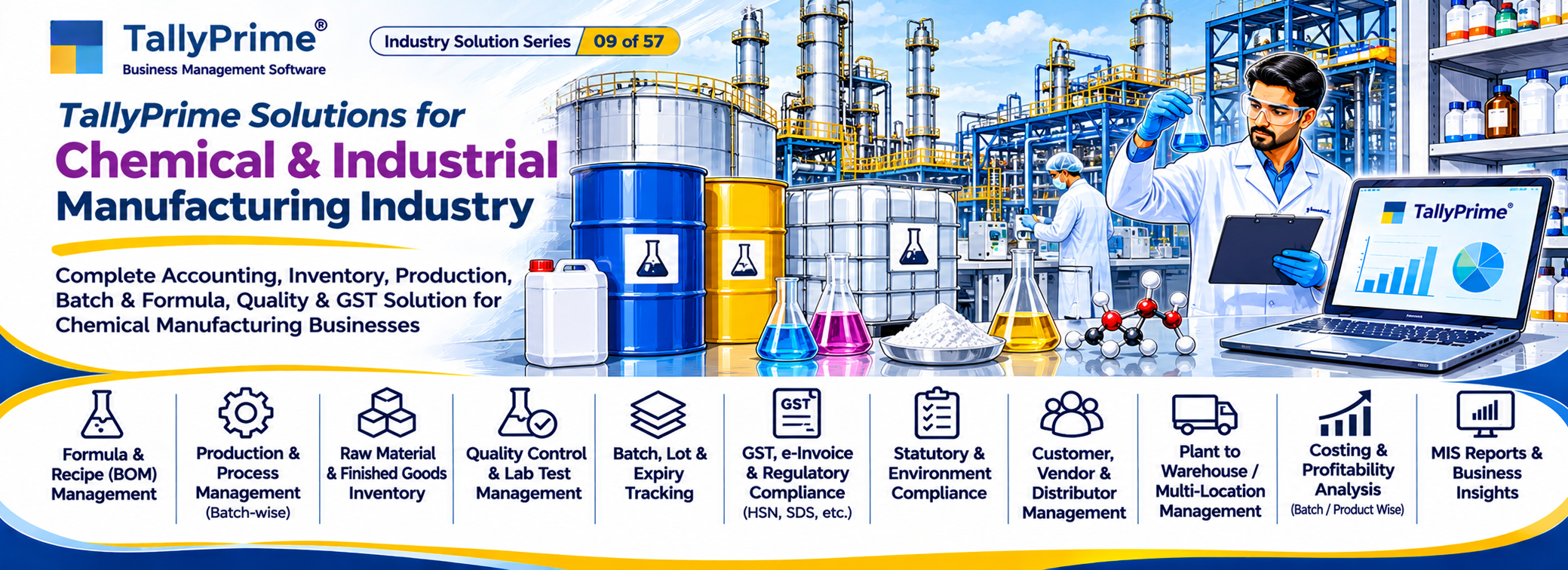
Introduction
The chemical and industrial manufacturing industry plays an important role in supplying raw materials, intermediate products and finished goods to a wide range of sectors, including pharmaceuticals, textiles, paints, plastics, construction, agriculture, automotive, packaging and consumer goods.
Chemical manufacturing businesses may produce industrial chemicals, solvents, adhesives, coatings, paints, detergents, specialty chemicals, fertilisers, lubricants and other chemical formulations.
Industrial manufacturers may also produce process materials, machine components, industrial consumables and specialised products used in factories and production facilities.
These businesses require careful management of raw materials, chemical formulations, production batches, inventory, quality records, packaging, storage, purchase, sales and financial accounting.
For example, a chemical manufacturer may purchase several raw materials, combine them according to a formulation, manufacture a batch, conduct quality testing, package the finished product and dispatch it to customers.
Managing these processes through separate spreadsheets and accounting records can create difficulties in tracking material consumption, production costs, batch information and inventory movement.
TallyPrime provides accounting and inventory features that can support many chemical and industrial manufacturing requirements. With appropriate configuration and customisation, businesses can extend TallyPrime to maintain formulation-related records, batch information, production entries, material consumption, quality details, packaging records and industry-specific reports.
At TallySolution.net, we provide TallyPrime customisation and TDL development services for chemical manufacturers, industrial product manufacturers, process industries and businesses requiring specialised manufacturing workflows.
Our dedicated team of 32+ developers works across Delhi, India and internationally, developing customised solutions according to business requirements.
Why Chemical and Industrial Manufacturers Need Customised TallyPrime Solutions
Chemical and industrial manufacturing businesses often deal with complex production and inventory processes.
Common business requirements include:
- Raw material inventory
- Chemical formulation management
- Batch-wise production
- Material consumption
- Production planning
- Work-in-progress
- Finished goods inventory
- Batch identification
- Quality inspection records
- Packaging management
- Product costing
- Supplier management
- Customer order management
- Warehouse management
- GST-related accounting
- Production and financial reporting
Chemical products may also require specific handling, storage and documentation procedures.
A customised TallyPrime solution can help businesses organise their accounting and inventory information while supporting additional workflows through suitable custom development.
TallyPrime Features for Chemical and Industrial Manufacturing
1. Raw Material Inventory Management
Chemical manufacturers purchase a wide variety of raw materials.
These may include:
- Industrial chemicals
- Solvents
- Resins
- Acids
- Bases
- Pigments
- Additives
- Oils
- Powders
- Granules
- Industrial compounds
- Packaging materials
TallyPrime supports stock groups, stock items, units of measurement and inventory locations.
These features can be configured to organise raw materials according to:
- Material category
- Chemical name
- Material code
- Supplier
- Grade
- Specification
- Storage location
A customised raw material module can provide additional fields such as technical grade, concentration, supplier batch reference and internal material identification.
This helps businesses maintain structured raw material records.
2. Chemical Batch Management
Batch management is important for chemical manufacturing because products may be manufactured in different production batches.
A batch may have specific information such as:
- Batch number
- Manufacturing date
- Raw material references
- Production quantity
- Quality status
- Packaging details
- Dispatch information
TallyPrime supports batch-related inventory tracking in applicable configurations.
A customised batch management module can provide additional information such as:
- Internal production batch
- Supplier batch reference
- Manufacturing date
- Batch status
- Quality approval
- Batch-specific remarks
This can help businesses identify and trace inventory by batch.
3. Chemical Formulation Management
Many chemical products are manufactured according to a specific formulation.
A formulation may define the quantity or percentage of each raw material required to produce a finished product.
For example, a manufacturer producing an industrial coating may use a combination of resins, pigments, solvents and additives.
A customised formulation management module can record:
- Product name
- Formulation code
- Version number
- Raw material
- Required quantity
- Percentage composition
- Expected output
- Production instructions
The actual formulation should be maintained securely and accessed only by authorised personnel.
Where technically feasible, a customised system can connect formulation records with manufacturing and inventory workflows.
4. Bill of Materials for Chemical Manufacturing
A Bill of Materials (BOM) defines the components or materials required to manufacture a product.
In chemical manufacturing, a BOM may represent the ingredients required for a particular batch or production quantity.
TallyPrime supports BOM and manufacturing-related inventory workflows in applicable configurations.
A customised BOM module can provide additional information such as:
- Product formulation reference
- Raw material specifications
- Batch quantity
- Expected yield
- Packaging requirements
- Production version
This can help manufacturers organise material requirements for production.
5. Production Batch Recording
Chemical manufacturers may produce goods through mixing, blending, processing, heating, cooling or other manufacturing operations.
A customised production batch module can record:
- Production order
- Product
- Batch number
- Production date
- Raw materials issued
- Quantity consumed
- Finished quantity
- Rejected quantity
- Production status
This helps businesses maintain production records and compare expected output with actual production.
Material Consumption and Production Yield
1. Raw Material Consumption
Manufacturers need to know how much raw material is consumed during production.
A customised material consumption module can record:
- Production batch
- Raw material
- Quantity issued
- Quantity consumed
- Quantity returned
- Quantity remaining
This can help inventory teams reconcile raw material usage.
2. Production Yield
Production yield refers to the quantity of usable finished product obtained from the manufacturing process.
A customised production yield report can compare:
- Planned production quantity
- Actual input quantity
- Expected output
- Actual output
- Process loss
- Rejected quantity
For example, a manufacturer may plan to produce 1,000 kg of a chemical product but obtain 970 kg of finished material after processing.
The system can record the actual output and the difference from the planned quantity.
3. Wastage and Process Loss
Chemical manufacturing may involve process loss, residue, evaporation, rejected material or other production-related wastage.
A customised wastage module can record:
- Production batch
- Material
- Wastage quantity
- Wastage category
- Reason
- Responsible department
- Disposal or recovery information, where applicable
This can help management analyse material losses and improve production control.
The treatment of waste and hazardous material must follow the business's applicable safety and environmental procedures.
Quality Control and Inspection Management
Quality control is essential in chemical and industrial manufacturing.
Products may need to meet specific technical specifications before being approved for sale.
1. Quality Inspection Records
A customised quality inspection module can record:
- Product
- Batch number
- Inspection date
- Test parameter
- Test result
- Specification
- Quality status
- Inspector
This can help businesses maintain quality-related records.
2. Batch Approval
A manufacturer may require quality approval before finished goods are released for sale.
A customised batch approval workflow can include:
- Production batch completed
- Quality inspection performed
- Results recorded
- Batch approved or rejected
- Finished goods released or held
The exact approval workflow depends on the company's quality management procedures.
3. Rejected and Reprocessed Materials
Some batches may fail quality inspection and require rejection or reprocessing.
A customised module can record:
- Batch number
- Rejection reason
- Quantity rejected
- Reprocessing reference
- Additional material consumed
- Final quality status
This can help businesses maintain better production and quality records.
Finished Goods and Packaging Management
Chemical manufacturers may sell products in different packaging sizes.
Examples include:
- Small bottles
- Cans
- Drums
- Barrels
- Bags
- Containers
- Bulk tankers
A customised packaging management module can record:
- Finished product
- Batch number
- Packaging type
- Packaging quantity
- Net weight
- Gross weight
- Number of packages
- Packaging material consumed
This helps manufacturers manage finished goods according to packaging requirements.
Packaging Conversion
A manufacturer may produce a bulk quantity and pack it into smaller units.
For example, 1,000 litres of a product may be packed into 200 containers of 5 litres each.
A customised packaging workflow can record the bulk quantity, packaging quantity and finished stock generated.
The system configuration should account for the company's units of measurement and inventory practices.
Purchase and Supplier Management
1. Supplier-Wise Purchase Management
Chemical manufacturers may purchase raw materials from multiple suppliers.
A customised supplier management module can maintain:
- Supplier name
- Material supplied
- Supplier material code
- Grade
- Specification
- Purchase rate
- Delivery terms
- Payment terms
This can help purchase teams maintain supplier information.
2. Supplier Batch References
Raw materials may arrive with supplier batch numbers or certificates.
A customised purchase receipt workflow can record:
- Supplier batch number
- Material
- Quantity received
- Receipt date
- Supplier
- Purchase invoice
- Quality inspection reference
This can help businesses connect incoming material records with production batches.
3. Purchase Order Tracking
A customised purchase order module can maintain:
- Purchase order number
- Supplier
- Material
- Ordered quantity
- Received quantity
- Pending quantity
- Expected delivery date
- Order status
This helps businesses monitor pending material deliveries.
Sales and Customer Management
Chemical manufacturers may sell products to:
- Industrial customers
- Distributors
- Dealers
- Manufacturers
- Institutional buyers
- Export customers
A customised customer management module can maintain:
- Customer name
- Industry
- Product requirements
- Credit terms
- Sales history
- Customer-specific specifications
Customer-Wise Product Pricing
Different customers may have different pricing arrangements.
A customised pricing module can support:
- Distributor pricing
- Dealer pricing
- Industrial pricing
- Bulk pricing
- Contract pricing
- Export pricing
The pricing structure depends on the business's commercial requirements and supported configuration.
Sales Order and Dispatch Tracking
A customised sales order module can record:
- Customer
- Product
- Batch
- Quantity
- Order date
- Dispatch date
- Delivery location
- Order status
This helps businesses coordinate sales, inventory and dispatch.
Product Traceability
Traceability is important for chemical manufacturers because businesses may need to identify the raw materials used in a finished product.
A customised traceability module can connect:
- Supplier
- Raw material
- Supplier batch
- Production batch
- Finished product
- Customer
- Sales invoice
- Dispatch reference
This can help businesses trace a finished product back to its input materials.
It may also support investigation of quality complaints and product returns.
The depth of traceability depends on the records maintained and the customisation implemented.
Industrial Manufacturing and Process Management
Industrial manufacturers may produce specialised products through different production processes.
Examples include:
- Industrial lubricants
- Adhesives
- Paints and coatings
- Industrial cleaners
- Metal treatment products
- Process chemicals
- Industrial compounds
- Manufacturing consumables
A customised industrial manufacturing module can record:
- Production order
- Product specification
- Raw material requirements
- Production stages
- Machine or process reference
- Quantity produced
- Quality status
- Finished goods
For businesses with multiple production stages, customised reports can be developed to monitor material movement and production progress.
Advanced process control, machine integration and automated production monitoring may require separate software or hardware integration.
Product Costing and Manufacturing Expenses
Chemical manufacturing costs may include:
- Raw materials
- Packaging materials
- Direct labour
- Power and fuel
- Production overheads
- Testing expenses
- Freight
- Storage
- Other manufacturing expenses
A customised product costing module can analyse the cost of manufacturing each product or batch.
Possible costing information includes:
- Material cost
- Packaging cost
- Labour cost
- Production overhead
- Total batch cost
- Cost per unit
- Expected selling price
- Gross margin
This helps management evaluate manufacturing costs and pricing.
Cost allocation should be based on the company's approved accounting policy.
Warehouse and Storage Management
Chemical manufacturers may store raw materials and finished goods in different warehouses or storage areas.
TallyPrime supports inventory locations and stock tracking.
A customised warehouse management module can provide:
- Warehouse
- Storage location
- Material category
- Batch number
- Quantity
- Stock status
- Dispatch status
Where required, additional fields can be developed for storage references and internal identification.
Storage and handling procedures for chemicals must be managed according to applicable safety requirements.
Accounting and GST Management
TallyPrime provides accounting features that can support chemical and industrial manufacturing businesses.
Accounting workflows may include:
- Raw material purchases
- Finished goods sales
- Production-related expenses
- Supplier payments
- Customer receipts
- Bank reconciliation
- Inventory accounting
- GST-related accounting
- Credit notes
- Debit notes
- Customer outstanding
- Supplier outstanding
- Profit and loss reporting
Businesses dealing with different chemical products may require appropriate product classification and tax configuration.
GST settings should be reviewed according to the nature of the products and applicable regulations.
Reports for Chemical and Industrial Manufacturing Businesses
A customised TallyPrime solution can provide reports across inventory, production, quality and financial accounting.
Raw Material Reports
- Raw material stock
- Supplier-wise purchases
- Batch-wise inventory
- Material consumption
- Material issue register
- Stock ageing
- Warehouse-wise stock
Production Reports
- Production batch register
- Production order status
- BOM consumption
- Actual material consumption
- Production yield
- Process loss
- Finished goods production
Quality Reports
- Batch inspection register
- Quality approval status
- Rejected batch report
- Reprocessing register
- Quality complaint history
Sales Reports
- Product-wise sales
- Customer-wise sales
- Batch-wise dispatch
- Pending sales orders
- Customer outstanding
- Sales margin
Financial Reports
- Product-wise costing
- Batch-wise costing
- Profit and loss
- Balance sheet
- Cash and bank
- Supplier outstanding
- GST-related reports
How We Implement TallyPrime Customisation for Chemical Manufacturers
At TallySolution.net, we follow a structured implementation process.
Step 1: Understand the Manufacturing Process
We identify the company's products, raw materials, formulations, production stages, packaging and quality requirements.
Step 2: Configure Standard TallyPrime Features
We configure available accounting, inventory, batch and manufacturing-related features according to the business requirements.
Step 3: Identify Custom Modules
We identify additional requirements such as:
- Formulation management
- Production batch tracking
- Material consumption
- Production yield
- Quality inspection
- Batch approval
- Packaging management
- Traceability
- Product costing
- Custom dashboards
Step 4: TDL Development
Where technically feasible, Tally Definition Language can be used to develop additional fields, reports, calculations and supported workflows.
Custom development depends on the business requirements, TallyPrime configuration and applicable licensing.
Step 5: Testing
The solution is tested using representative transactions, including:
- Raw material purchase
- Material receipt
- Batch creation
- Production entry
- Material consumption
- Finished goods entry
- Quality approval
- Packaging
- Sales invoice
- Batch dispatch
Step 6: Training and Deployment
Users are trained in the customised workflow before deployment.
The final implementation is designed around the company's operational and accounting requirements.
Why Choose TallySolution.net?
Chemical and industrial manufacturing businesses require accurate control over raw materials, formulations, production batches, quality records, packaging, finished goods and costs.
TallySolution.net provides TallyPrime customisation and TDL development services for businesses requiring industry-specific functionality.
Our team can work on requirements involving:
- Chemical inventory management
- Raw material management
- Formulation records
- BOM management
- Batch-wise production
- Material consumption
- Production yield
- Wastage tracking
- Quality inspection
- Batch approval
- Packaging management
- Product traceability
- Product costing
- Warehouse management
- Custom reports and dashboards
We support chemical and industrial manufacturers in Delhi NCR, across India and internationally.
Our objective is to help businesses organise accounting and inventory records while supporting their manufacturing and operational workflows.
Frequently Asked Questions
1. Can TallyPrime be used for chemical manufacturing?
Yes. TallyPrime supports accounting and inventory management, and applicable manufacturing features can be configured for chemical manufacturing workflows.
2. Can we maintain batch-wise chemical inventory?
Yes. Batch-related inventory tracking is available in applicable configurations. Customisation can provide additional batch information and reports.
3. Can we maintain chemical formulations?
A customised formulation module can maintain product recipes, material quantities and formulation references, subject to technical feasibility.
4. Can we manage raw material consumption?
Yes. Manufacturing and customised material consumption workflows can record raw materials issued and consumed during production.
5. Can we track production yield?
A customised production yield report can compare planned input, actual input and finished output.
6. Can we maintain quality inspection records?
Yes. A customised quality inspection module can record batch details, test parameters, results and approval status.
7. Can we trace finished products to raw materials?
A customised traceability module can connect supplier batches, raw materials, production batches and finished goods.
8. Can we manage packaging?
Yes. A customised packaging workflow can record packaging materials, quantities, container sizes and finished goods.
9. Can we calculate product-wise manufacturing costs?
A customised costing module can analyse material costs and other allocated manufacturing expenses.
10. Can you develop a customised chemical manufacturing solution?
Yes. TallySolution.net can study the company's requirements and develop suitable TallyPrime customisations for batch management, formulation records, production, quality, costing and reporting.
Conclusion
Chemical and industrial manufacturing businesses require accurate management of raw materials, formulations, production batches, quality records, packaging, finished goods and manufacturing costs.
TallyPrime provides an accounting and inventory foundation that can support many of these requirements.
With suitable customisation, businesses can extend the system to manage formulation records, batch-wise production, material consumption, production yield, quality inspection, product traceability, packaging and manufacturing reports.
A properly configured solution can help chemical manufacturers and industrial businesses maintain organised records, improve inventory visibility and analyse production costs more effectively.
TallySolution.net provides TallyPrime customisation and TDL development services for chemical and industrial manufacturing businesses seeking industry-specific accounting, inventory, production and reporting solutions.
Contact our team to discuss your chemical or industrial manufacturing requirements.